
Know your progress · IPL education
How to tell if IPL is working.
Hair reduction rarely happens all at once. Discover what gradual progress can look like, how to compare regrowth fairly, and when to reassess your routine.
Explore the seven signs01 / Understanding results
Does IPL really work?
Intense pulsed light (IPL) delivers flashes of light that can be absorbed by pigment in the hair and converted into heat. With suitable equipment and repeated use, this can reduce hair regrowth. But a result for one device, hair type or person does not prove the same result for another.
What to look for is a trend over time: slower return of hair after shaving, fewer visible hairs, or less frequent shaving. No method guarantees permanent, complete or pain-free hair removal.
02 / What to notice
Seven signs your IPL routine may be making a difference.
Not everyone experiences all seven signs, and some overlap. None confirms effectiveness on its own.
- 01
Regrowth seems slower
You notice more days passing before new hair becomes visible after shaving.
- 02
Hair coverage looks less dense
Comparisons at the same point after shaving may show fewer visible hairs, sometimes unevenly across the area.
- 03
Some hairs look finer
Regrowth may appear less coarse in some treated areas, although hair texture alone is not a reliable measure.
- 04
You shave less often
Keeping a record of your usual shaving frequency can make subtle changes easier to notice.
- 05
Smoothness lasts longer
You may have more time between the return of noticeable stubble.
- 06
Some treated hairs shed
Hair may appear to push out or shed after treatment; this is not a guarantee that every follicle has responded.
- 07
Repeat photographs show a difference
Photos captured under the same conditions can show changes that are difficult to judge from memory.
03 / Timing
When should you notice a difference?
There is no universal number of days or sessions. Results depend on the device, settings, treatment area, natural hair colour, skin tone, hair-growth cycle and consistency of use. Treat dramatic timelines in advertising with caution unless they are supported by evidence for that specific product.
Still seeing some hair three or four weeks after a treatment is not, by itself, proof of failure. Equally, sparse-looking growth in one image cannot establish that IPL caused it. Compare against your own baseline under similar conditions rather than against someone else's results.
Follow your device's stated treatment schedule. Do not increase treatment frequency or intensity beyond its instructions to chase faster changes.
04 / A real-world example
What visible regrowth can look like.
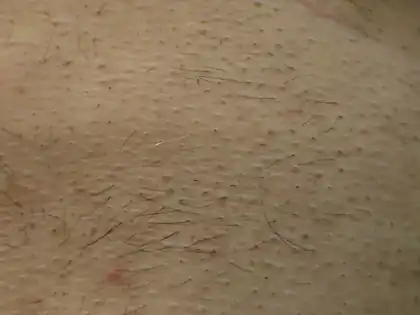
Here is a real photograph shared by someone using IPL at home, taken about three to four weeks after their most recent session. It shows scattered visible hairs, short stubble and visible follicular openings.
What this image can tell us: there is still visible hair on the photographed area. What it cannot tell us: whether there has been a measurable reduction in density, whether IPL caused the visible pattern, or how much hair may return later.
Without a same-area, same-lighting baseline and the time since the last shave, even a detailed close-up should be treated as an observation rather than a verified before-and-after result.
05 / Compare fairly
A more reliable way to photograph regrowth.
Use a repeatable setup, not just an attractive photo. Choose a small, clearly defined area and take a baseline image before beginning the course.
- Choose one area. Use the same patch of skin each time, away from identifying marks if you plan to share an image.
- Match the timing. Take comparison photographs at the same number of days after shaving; otherwise different hair lengths can be misleading.
- Match the setup. Keep camera distance, angle, lighting and focus as consistent as possible. Avoid changing flash conditions.
- Record the context. Note the date, treatment area, time since last shave and the number of sessions completed. You do not need to photograph after every flash.
- Look for trends. Compare several observations rather than judging a single image.
Dark dots, visible follicles and scattered hairs may have several explanations, including normal regrowth. Photographs cannot tell you whether a specific follicle has permanently stopped producing hair.
06 / Your progress tracker
Track changes without guessing.
Enter your approximate observations below. This simple tool runs in your browser, does not upload photographs, and does not save data to CYPH/1. Copy the summary if you want to retain it.
Your observations
Choose your observations to generate a simple progress summary. This is not a diagnostic test.
The “5 or more days” choice is a range, not a precise measurement. The tracker intentionally makes no percentage-improvement or effectiveness claim.
07 / Troubleshooting
What if you're not seeing results?
First, check whether your natural hair colour and skin tone are within the permitted range for your particular device. IPL may be unsuitable or ineffective for certain combinations, and using it on unsuitable skin can cause injury. Review the manual's contraindications and patch-test advice.
Next, consider whether you're comparing like with like: same body area, similar time after shaving, consistent observations, and the full course recommended in the instructions. Differences between body areas and hair-growth cycles can make results look uneven.
If you remain unsure after following the product's recommended course, consult the manufacturer's guidance or an appropriately qualified professional. Do not treat irritated, injured or otherwise contraindicated skin, and seek medical advice for a burn or persistent adverse reaction.
08 / Continue learning
Understand the routine behind the results.
09 / Sources
Evidence and safety guidance.
These references provide general background on IPL, hair cycles and appropriate advertising claims. They are not clinical test results for the CYPH/1 device.
Cycle. Phase. One.
Progress starts with understanding.
Explore CYPH/1's approach to at-home IPL. This educational article does not promise outcomes for a particular device.
Explore CYPH/1